

A patient unable to get relief from TCM and chiropractor care
One of my patients had been dealing with neck pain with numbness down the right arm for months. He’d seen multiple traditional Chinese medicine (TCM) practitioners and chiropractors. The treatments helped… but the pain always came back.
Then one day, the pain escalated — numbness and soreness spread down his left arm. In a rush, he went to see a neurologist.
For cases like his, patients usually end up with either:
- An orthopaedic doctor, who orders an MRI to check for nerve compression. If it’s not severe enough for surgery, they often refer patients straight to physiotherapy.
- A neurologist, who often gives a detailed breakdown of exactly which spinal segment is affected, what’s pressing on the nerve, and what kind of joint mobilisation the therapist should use.
A Typical Posture, an Atypical Finding
Like many office workers, my patient spent over ten hours a day hunched in front of a computer — the classic turtle neck plus dowager’s hump posture.
But what I found during examination was a pleasant surprise for the patient:
- His neck muscles were so weak that when I applied gentle pressure, his neck collapsed like a swamp.
- Apart from skin and fascia, there was barely any muscular support along his spine.
This isn’t rare. Many people with chronic neck pain have muscle atrophy in the deep stabilising muscles of the neck. Even if soft tissue is felt on palpation, MRI scans often reveal fatty infiltration — tissue that offers no real support to the cervical spine.
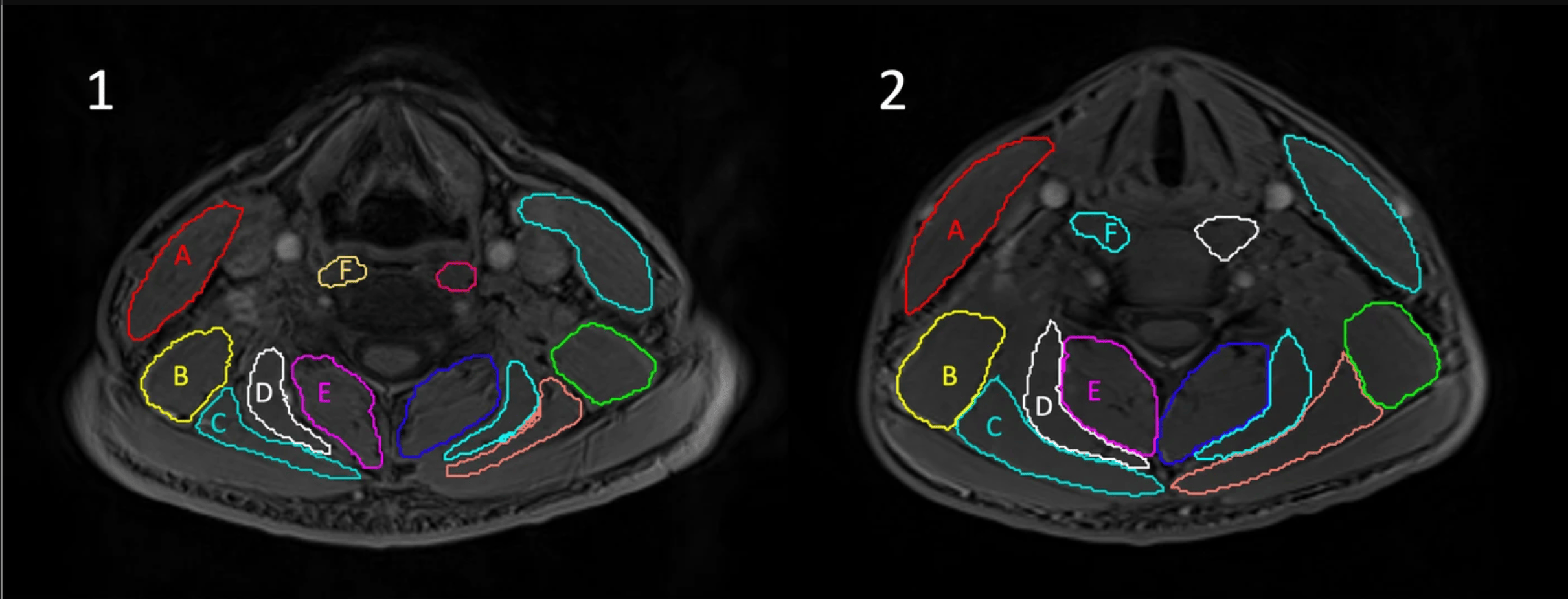
Why Physiotherapy Is Different
Out of all healthcare providers, physiotherapists are the ones who directly assess and train the muscles that control and stabilise the neck.
In my clinic, I often see patients who’ve had rounds of passive treatments — acupuncture, chiropractic adjustments — which may offer short-term relief but don’t address the underlying weakness.
Training the Neck’s “Core”
The first step is usually manual therapy to release tight muscles and nerves, preparing the deep neck muscles for activation.
When I was in university, we used a pressure biofeedback device to monitor subtle anterior neck flexor movements involving the skull, C1, and C2 vertebrae. Research showed this improved neck stability.
Today, we focus on training the deep muscles that hold the neck against gravity without over-relying on large superficial muscles like the sternocleidomastoid or scalenes.
These exercises are often enough to restore normal function for office work.
But if a patient wants to return to high-intensity sports — football, or even the extreme G-forces of Formula 1 racing — then a more advanced programme is needed, developed in collaboration with strength and conditioning coaches.
Neck Pain Exercises for aspecific Neck Pain | Deep Cervical Flexors & Extensors
A Case of Measurable Progress
One female patient was shocked to discover her neck muscles were too weak to even support her head.
After three weeks of consistent training, her desk tolerance improved from ten minutes, to thirty minutes, to an hour. One day, she realised she’d made it from morning until lunchtime without any neck pain at all.
Takeaway
When people injure their knees, they’re quick to strengthen their thigh muscles. When shoulders hurt, they work on the rotator cuff.
But when it comes to neck pain — few think about training their neck muscles.
It’s time we apply the same logic to the neck.
References:
Garzonio, S., Arbasetti, C., Geri, T., Testa, M., & Carta, G. (2022). Effectiveness of Specific Exercise for Deep Cervical Muscles in Nonspecific Neck Pain: A Systematic Review and Meta-Analysis. Physical therapy, 102(5), pzac001. https://doi.org/10.1093/ptj/pzac001
Giménez-Costa, M., Schomacher, J., Murillo, C., Blanco-Hernández, T., Falla, D., & Lluch, E. (2022). Specific versus non-specific exercises for the neck extensor muscles in women with chronic idiopathic neck pain: A randomized controlled trial. Musculoskeletal science & practice, 60, 102561. https://doi.org/10.1016/j.msksp.2022.102561
Li, Z., Liang, Q., Li, H., Lin, X., Meng, J., Yang, D., Li, C., Liang, Y., Yang, Y., Lin, Y., & Liang, Z. (2023). Fatty infiltration of the cervical multifidus musculature and its clinical correlation to cervical spondylosis. BMC musculoskeletal disorders, 24(1), 613. https://doi.org/10.1186/s12891-023-06595-4
Snodgrass, S. J., Weber, K. A., 2nd, Wesselink, E. O., Stanwell, P., & Elliott, J. M. (2024). Reduced Cervical Muscle Fat Infiltrate Is Associated with Self-Reported Recovery from Chronic Idiopathic Neck Pain Over Six Months: A Magnetic Resonance Imaging Longitudinal Cohort Study. Journal of clinical medicine, 13(15), 4485. https://doi.org/10.3390/jcm13154485
Snodgrass, S.J., Stanwell, P., Weber, K.A. et al. (2022) Greater muscle volume and muscle fat infiltrate in the deep cervical spine extensor muscles (multifidus with semispinalis cervicis) in individuals with chronic idiopathic neck pain compared to age and sex-matched asymptomatic controls: a cross-sectional study. BMC Musculoskelet Disord 23, 973 . https://doi.org/10.1186/s12891-022-05924-3
Leave a Reply